ABOUT THIS BLOG:

ABOUT THIS BLOG: Much like myself, this site has worn down with many of its features no longer functioning. If you have questions (or answers), feel free to contact me: @WillTinkhamfictionist (Facebook) or @willtink (Twitter / Instagram / Threads). Thanks!

EVERY TIME SHE SHOUTED FIRE

EVERY TIME SHE SHOUTED FIRE
A combustible tale of family and friendship, young love and arson. (Click cover to order.)

About Me

My photo
Will Tinkham has published twelve novels. THE RELUCTANT NAZI follows THE PACKARD SALESMAN, THE TEDDY & BARA SHOW, IF I LIE IN A COMBAT ZONE, FALLING DOWN UMBRELLA MAN, THE MIRACLES, THE CARY GRANT SANATORIUM AND PLAYHOUSE, THE GREAT AMERICAN SCRAPBOOK, THE ADVENTURES OF HANK FENN, BONUS MAN, NO HAPPIER STATE, and ALICE AND HER GRAND BELL. He lives and writes in Minneapolis, MN. His short fiction has been published on three continents and he long ago attended Bread Loaf on a scholarship. An actor of little renown, his credits do include the Guthrie Theater and Theatre in the Round. @WillTinkhamfictionist on Facebook, @willtink on Twitter, instagram.com/willtink
Showing posts with label fiction. Show all posts

Tuesday, May 5, 2020

On freebies

From time to time I give away Kindle copies of my novels in an attempt to attract readers. My last three giveaways before this year netted 2, 2 and 3 people jumping on my offers. Free books. I could barely give them away. My most successful freebie days had been 21, 73 and a confounding 305 copies of The Adventures of Hank Fenn back in 2016.


I tried Hank this past Sunday for a two-day freebie event. Gave away 8 copies on Sunday, and was surprised when a freelance editor tweeted about it. I recalled her because she'd had good things to say about the same book back in '16. I retweeted the tweet.
Gave away 268 copies on Monday. Perhaps I should rethink Twitter as a marketing tool.

This morning I discovered I'd actually sold three books during/since the giveaway. Plus, someone started reading (36 pages, so far, per the Amazon chart) Hank Fenn on Kindle Unlimited.

For the record, those three purchases quadrupled my sales total for the year. Yes, perhaps I should rethink Twitter.

Thursday, March 12, 2015

On pre-order

My second novel, NO HAPPIER STATE, is now on pre-order here, with a release date set for March 18. The paperback will also go on sale on that date. It goes like this:


While the menfolk carve Mount Rushmore above, Pêche Appleton sells her own tiny sculptures to the Depression-era onlookers below. Some find them offensive, particularly Taft-Stuck-in-a-Bathtub, the Cancan-Dancing-Presidents, and the whole Jefferson-and-the-Slave-Girl series. Pêche is married to Ernie, star shortstop for the town team, and NO HAPPIER STATE is their story of love, small town scandal and national political outrage.

Their love is at first sight when they're twelve. The scandal revolves around the baby. The outrage involves their friends: Steinke, a German-born Jew, sent to an internment camp because the Japanese bomb Pearl Harbor and Bad Glove Hand, a Lakota Sioux, heads for Hollywood only to be blacklisted as a Communist—but not before implicating actor Ronald Reagan in the same plot.

Despite their own personal burdens—and the Depression and a World War—love and friendship prevail in NO HAPPIER STATE (Americana #2).

Also, ALICE AND HER GRAND BELL (Kindle version) is FREE March 12 & 13. Plus, we just received a new Amazon review!

Monday, November 24, 2014

On Amsterdam Reading

VIDEO PROOF

So the Almanac reading at the Amsterdam was a wonderful event. A wide array of readers, a nice crowd, no fights erupted at the bar. Personally, after an early glitch, it went off nicely, though I'd have to see the video to be sure.

First thing I noticed when I arrived was that there was no podium on stage. Every reading I've ever taken part in had a podium. No big deal, you might think, but if you have Essential Tremors—like me—it's kind of a big deal. It's not a nervous thing; the tremors just happen—home alone, my hands shook as I practiced reading from the book. I sought out the man in charge, David Stein, and explained my situation. He scrounged a music stand from somewhere and announced that it was there for any of the readers to use. Of course, I was the only one in need.

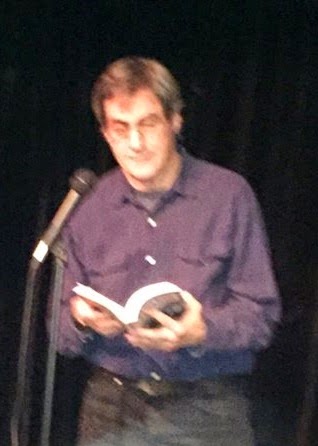
When he introduced me about halfway into the show, I jumped onstage, dragged the stand to the mic, struggled mightily to get it to the proper height—all the while wondering what the crowd must be thinking of this guy who required a stand while others had read from their books or their phones. (If you're curious about the photo that accompanies this post: It was staged, after the fact, by my friend John Lutter. Looking at it you'd think I was as steady as the next guy, wouldn't you?)

Like I said, my part seemed to go smoothly after that. If the video affirms that I'll post it here, if not you're on your own finding it...

Friday, September 12, 2014

Fraud on the 21

Last night I rode the 21A for an hour and 15 minutes to attend the book launch for the 2015 Saint Paul Almanac. Despite being a stranger in a strange town, I found the Black Dog Cafe and ventured inside, eventually finding my free copy, a $50 check and getting a rose pinned to my lapel—all for having a story in their wonderful book. They had speakers and readers, all singing the praises of their home city of Saint Paul. There were childhood memories, reflections on buildings and attractions long since gone; a five-year-old even danced to the spirits of indigenous peoples who inhabited the area thousands of years ago. I felt guilty for crashing their party.

I stole out of town the same way I came in, on the 21. Now I had the Almanac to read. I read about old chocolate factories, Red Owl groceries, kids playing hide-and-seek amid coffins. I read true stories of generations growing up and growing old in Saint Paul. Why was I in this book? I'd spent most of my adult life in Minneapolis. I'd written a fictional tale of a fictional doctor taking a fictional bullet out of John Dillinger's shoulder. Had I taken their money and space in their book on false pretenses? I opened the Almanac to my bio: sure enough, I hadn't even bothered to fess up to being from Minneapolis. Fraud!

Was I any better than Dillinger himself? He took advantage of the hospitality Saint Paul had to offer, then blew town with his ill-gotten gains. As the 21 pulled into the Uptown Station, I checked my coat pocket for that check—my own filthy lucre—and vowed...nothing. Who was I kidding? I'd never change. I slunk back to my Minneapolis apartment. I'm not proud of the path my life has taken. Once a writer always a writer. So shoot me...


(Look, I even lifted that picture of the dancing kid from the Almanac FB page! Have I no shame?)

Friday, September 13, 2013

On another publication


Found out this morning that my short story, “The Difference,” will be published in Skive Magazine in their FAREWELL November issue. Skive is out of Australia and a few years back published an excerpt from my first novel. It's their last issue, which is a shame, but I'm thrilled to be a part of it.

Monday, September 17, 2012

A good week

Okay, I know it's been nearly two months since my last post but nothing was going on, till last week: On Thursday I got a phone call from Tom Jenks (current Narrative Magazine fiction editor, former Esquire fiction editor) accepting me into a writers' workshop he runs in San Francisco. I submitted the first three chapters of No Happier State by way of applying for the course and we spent 35 minutes discussing that and other things. He said my manuscript lacked direction and perspective. (One could probably use that to sum up my whole life...) Anyhow, that happens in January.
Then, Saturday morning, I received an email from About Place Journal telling me that an excerpt from the same novel would be included in their “Peaks and Valleys” issue. Should be out soon and I'll post a link.

Monday, July 23, 2012

Another excerpt


As promised earlier, here's the link to another excerpt from No Happier State, published in the latest issue of The Fieldstone Review. It's the last one: “The Only Good Indian.” I could make a big deal out of them deciding to call me William rather than Will, but I won't...

A review


Somewhere in this link you'll find my review of Mary Vettel's Death at the Drive-In. Buy it now on Amazon! Details also in that link.

Tuesday, July 3, 2012

On Another Publication


Just found out another excerpt from No Happier State will be published shortly in the 2012 edition of The Fieldstone Review. It's a wonderful publication out of the U. of Saskatchewan. My last four publications have been Australia, France, France and now Canada. Why can't I get pubbed in the US?
I believe the edition's theme is "shredded daisies" and I don't pretend to know exactly what they were after except that the stories should be political in nature. "The Only Good Indian" introduces Bad Glove Hand, a Lakota Sioux dealing with the contradictions involved with his working on Mount Rushmore. (More on Bad Glove on the left edge of this page.) Will post a link in the next few weeks.

Wednesday, February 2, 2011

On Meeting Raymond Carver

[Wikipedia: Raymond Clevie Carver, Jr. (May 25, 1938 – August 2, 1988) was an American short story writer and poet. Carver is considered a major American writer of the late 20th century and also a major force in the revitalization of the short story in the 1980s.]

The University of North Dakota conducts a wonderful—free—writers' conference every March. Back in 1986 I attended because Raymond Carver was to be the featured writer. Carver had studied under John Gardner (see earlier post), so I figured I had a minor connection and, as much as I wanted to meet Carver, I was also curious as to any insights he might have regarding Gardner.

Carver didn't arrive till the final day of the conference because of his wife-to-be Tess Gallagher's health. We went to a few parties that evening that Carver wasn't likely to attend (he'd long since quit drinking) and we finally made it to an on-campus gathering—that we likely weren't invited to—much later than I'd hoped.

We entered some sort of faculty club and there was Carver, putting his coat on and looking anxious to leave. I approached him anyway (it was my only shot) and extended my hand. "Mr. Carver," I said and introduced myself. He reluctantly shook my hand and said he was waiting for his driver. I mentioned a Georgia Review article he had written about Gardner, shortly after Gardner's death four years earlier. Carver smiled like he was pleased I'd at least done my homework. I went on to mention meeting Gardner two weeks before his motorcycle accident and his accepting a story of mine for publication. Carver took off his coat and we began to talk. His driver came down and Carver told him to wait. We talked for ten minutes about his early writing days with Gardner and my experience at Bread Loaf.

Raymond Carver died in 1988. He is sorely missed as a writer and—as I found out for ten minutes—a good guy.

Friday, January 21, 2011

On Meeting John Gardner

[Wikipedia: John Champlin Gardner, Jr. (July 21, 1933 – September 14, 1982) was an American novelist, essayist, literary critic and university professor. He is perhaps most noted for his novel GRENDEL, a retelling of the Beowulf myth from the monster's point of view.]

It was the spring of 1982 when I received a phone call from the Bread Loaf Writers' Workshop asking if I'd accept a scholarship to attend their conference that fall. The call itself was a shock and came just in time for me to escape a nasty roommate situation. They asked, would I be arriving by car, bus or plane?

"On foot," I replied. "I guess I'll be hitchhiking..." I lived in San Jose, CA. The conference is held in Middlebury, VT. I was in no hurry. I had little money, no place to live and plenty of time. It took two months. (If you hang around this blog long enough, I'll likely tell the hitchhiking story.)

Twenty-five young writers received "working scholarships" that year. The "working" was waiting tables, something I'd never done before. They asked for a volunteer to take the children's table in the corner; they said the few children that had been dragged by parents to the conference always sat at that table. This seemed about my speed. The first night the table was empty and I happily ran food and bussed tables. That night a rather drunken John Gardner was one of the opening night speakers. He addressed the crowd with a succinct: "If you're not writing politically, you're not writing shit!" and stomped out of the hall.

The next day's conversation obviously centered around Gardner's "speech." That night I was in the kitchen, helping out where I could, preparing for the dinner meal, when a fellow waitperson rushed into the kitchen. "Carolyn Forché and her people are at your table!" she screamed. I protested that it said "children only" right on the table. "Tim O'Brien's at your table!" another voice called out. That can't be, I demanded as the kitchen door opened and someone cried: "John Gardner and his entourage are at your table!"

The children's table had become the big shots table (along with jokes about it still being the children's table) but that was the least of my problems: John Gardner was my "reader" for the event and had left a note in my box—along with the stories I had submitted—to meet in a few days and discuss my work.

Arriving early for our meeting, I found a University of Minnesota wrestler named George seated on the very couch I was to meet Mr. Gardner at. "I have a meeting with John Gardner," George said. When Gardner arrived he apologized for the mix-up and asked George to return in twenty minutes. Twenty minutes, I thought. I hitchhike across country for an hour-long meeting with this guy and all the bastard gives me is twenty minutes. He took the stories from me—he'd made no notes on them—and proceeded to give me detailed critiques on each of the three. From memory.

He pointed to one story and said: "I bet you'd get some laughs if you read this one in front of a group." I explained that I had read it the night before at the scholarship winners reading and, yes, it got some laughs. "Sorry I missed it," he said, looking sufficiently contrite. He looked at his watch and I could see that my twenty minutes were up.

But there was no George in sight and, to keep things rolling, I said the first thing that came to mind: "So, what about the 'you're not writing shit' speech?"

"What's been the hot topic all week?" he asked.

"Your speech," I admitted.

"Exactly," he said, and still no George. After a pause, Gardner asked: "Where you from?" I said San Jose, then mentioned the two-month hitchhike. This seemed to impress him more than my writing. "How old are you?" he asked. I said twenty-five. "That's a good time to be published," he said and pointed to one of my stories: "Lop off the last line of this one and I'll publish it in my magazine, MSS." About then George arrived.

I got a ride to Wisconsin from a fellow waiter and a lift from Minneapolis to Wyoming for a friend's wedding. I was back in San Jose by September 15, when the paper ran the story about John Gardner and his motorcycle crashing over a cliff the day before.